WRC-1 Flipper, Children's myopia, hyperopia, amblyopia training, butterfly mirror, astigmatism vision adjustment
Product Description: WRC-1 Flipper
Revolutionize Your Vision Training with the WRC-1 Flipper, a state-of-the-art tool designed to enhance eye accommodation and alleviate visual fatigue. This scientifically-backed home training device is perfect for individuals of all ages, offering a comprehensive solution for myopia, hyperopia, amblyopia, and astigmatism.
What Makes the WRC-1 Flipper Unique?
The WRC-1 Flipper is an innovative vision training device that exercises the eye's ciliary muscle accommodation ability. By switching between positive (convex) and negative (concave) lenses, it simulates the natural process of focusing on objects at varying distances, thereby training and strengthening the eye's focusing system.
Who Will Benefit from the WRC-1 Flipper?
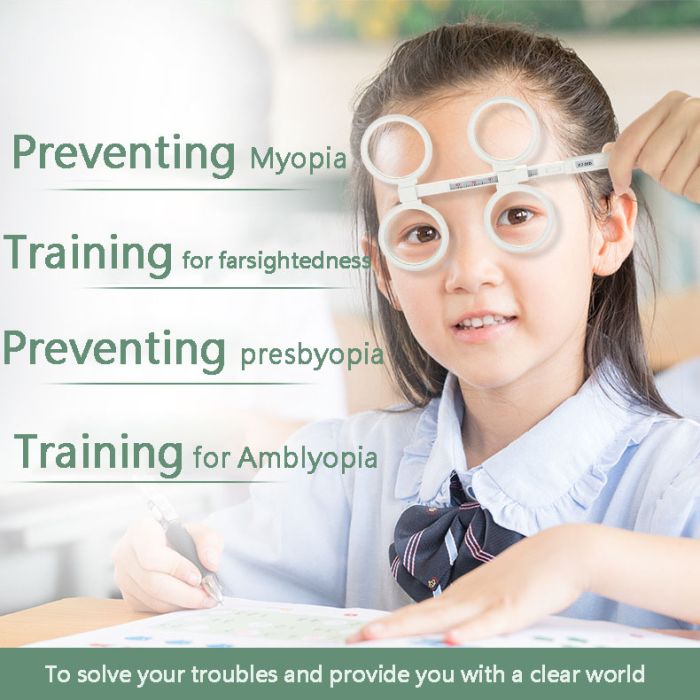
- Myopia (Nearsightedness): Slows progression and reduces eye strain.
- Hyperopia (Farsightedness): Enhances the eye's accommodative ability.
- Astigmatism: Supports overall visual function.
- Amblyopia (Lazy Eye): Integral part of a vision therapy program.
- Presbyopia (Age-Related Farsightedness): Delays and eases symptoms.
- Students & Teenagers: Ideal for those with high academic pressure and prolonged reading.
- Office Workers & Professionals: Designed for individuals facing computer screens for extended periods, often experiencing dry, tired, and strained eyes.
Slogan: "Unlocking Clear Vision for a Brighter World"
How Does the WRC-1 Flipper Work?
The training principle of the WRC-1 Flipper is based on simulating the natural adjustment of the eye:
- Positive Lens (Convex / +): Contracts the ciliary muscle, equivalent to looking at near objects.
- Negative Lens (Concave / –): Relaxes the ciliary muscle, equivalent to looking at far objects.
By flipping between these two lenses repeatedly, the ciliary muscle is trained through both contraction and relaxation, enhancing its flexibility and endurance – which is key to maintaining clear vision and reducing fatigue.
Product Structure & Key Features:
1. Dual-Lens Design:
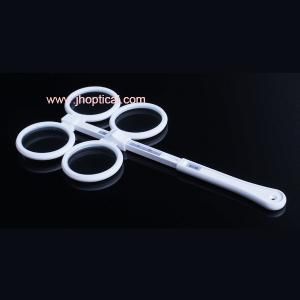
The WRC-1 Flipper features two sets of lenses – one set above and one below. Each set contains a positive and a negative lens, allowing for efficient alternating training.
2. Wide Pupillary Distance (PD) Adjustment Range:
Adjustable Range: 42mm – 86mm. This broad range ensures a comfortable fit for both children and adults, making it a versatile tool for the whole family. Before use, simply adjust the PD to match your own measurement for optimal visual alignment.
3. High-Quality Materials:
- Lens Material: Optical glass – ensures clear, distortion-free vision.
- Frame Material: High-quality plastic – lightweight (total product weight: 122g) and durable for long-term use.
4. Clear Identification Marks:
Both the lens degree and the PD scale are clearly marked on the frame, making it easy to identify and adjust settings during training.
How to Choose the Right Degree:
Selecting the appropriate training power is crucial for effective and safe training:
- Follow Professional Advice: If you have been examined by an optometrist, use the degree they recommend.
- Cost-Effective Choice: If you are unsure about your needs, a 200° lens is a common starting point. This number represents training intensity, not your actual refractive error (myopia/hyperopia).
- Progressive Training (Best Practice): For best results, consider purchasing a full set of degrees (e.g., 50°, 100°, 150°, 200°, 250°, 300°, 350°, 400°). Gradual progression from lower to higher degrees is more scientific and efficient.
How to Choose the Right Vision Card:
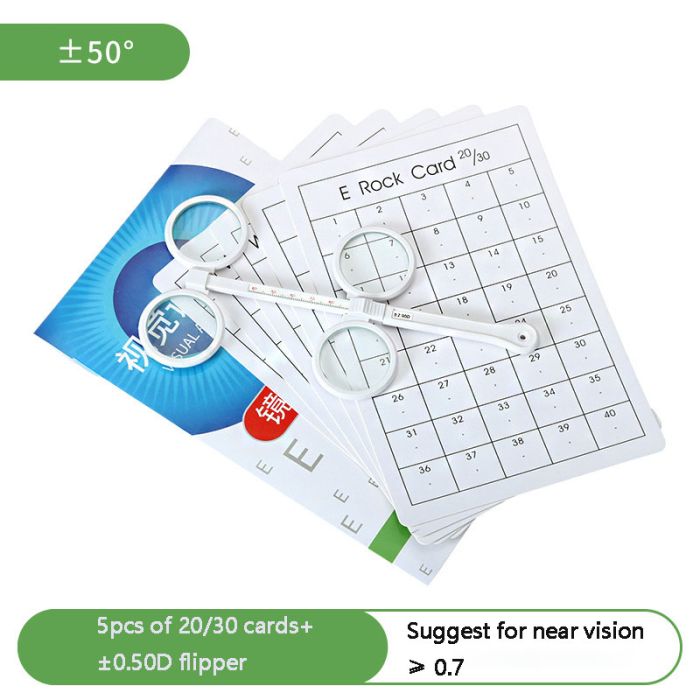
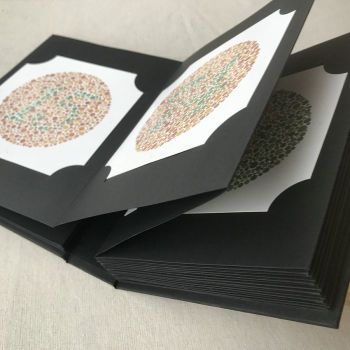
Three vision cards (20/30, 20/40, 20/50) are provided, with different optotype sizes. The principle is "easy first, difficult later."
- Near Visual Acuity:
- 0.7 or better: 20/30 (smaller optotypes)
- Between 0.7 and 0.5: 20/40
- 0.4 or lower: 20/50 (larger optotypes)
- Pro Tip: Start with the 20/40 card. Once you can read it clearly, switch to the 20/30 card for more challenging training and better results.
Step-by-Step Training Method:
- Preparation: Set the PD to match your own (range: 42–86mm) and position the chosen vision card at a distance of 40cm from your eyes. If you wear glasses for distance vision, keep them on during training. For amblyopia, start with the larger 20/50 card.
- Training Procedure: Hold the device by the handle, with one set of lenses (positive and negative) in front of your eye. Start flipping between the lenses, reading one character per lens side. Complete the cycle by reading all characters on the card one by one. Train each eye individually, then alternate.
- Training Frequency: Train 1–2 times daily, with each session lasting 10–15 minutes.
- Expected Results: A typical 15-day training course often leads to noticeable symptom improvement.
Important Precautions & Troubleshooting:
If you cannot see the optotypes clearly during training, please check the following:
- General blurriness: Wear your prescribed glasses during training. For amblyopia, start with the larger 20/50 card.
- Cannot see clearly with the positive lens: Move the training card closer to your eyes.
- Cannot see clearly with the negative lens: Move the training card farther away.
- Blurry vision despite adjustments: It may indicate insufficient ciliary muscle power. Switch to a lower-degree flipper and continue training.
- Difficulty starting: Start with monocular (single-eye) training. Take your time; it's okay to read slowly at first. The goal is to see clearly, not to rush.
Product Specifications at a Glance:
| Feature | Detail |
|---|---|
| Product Name | Double-Sided Butterfly Mirror (Flipper) |
| Product Weight | 122g |
| Product Material | Optical Glass + High-Quality Plastic |
| PD Adjustment Range | 42mm – 86mm (fits children & adults) |
| Main Purpose | Myopia, Hyperopia, and amblyopia training |
| Included Components | Adjustable flipper unit, set of vision cards, storage case |