How to use the differnent lenses in the trial lens set
Usage of the trial lens
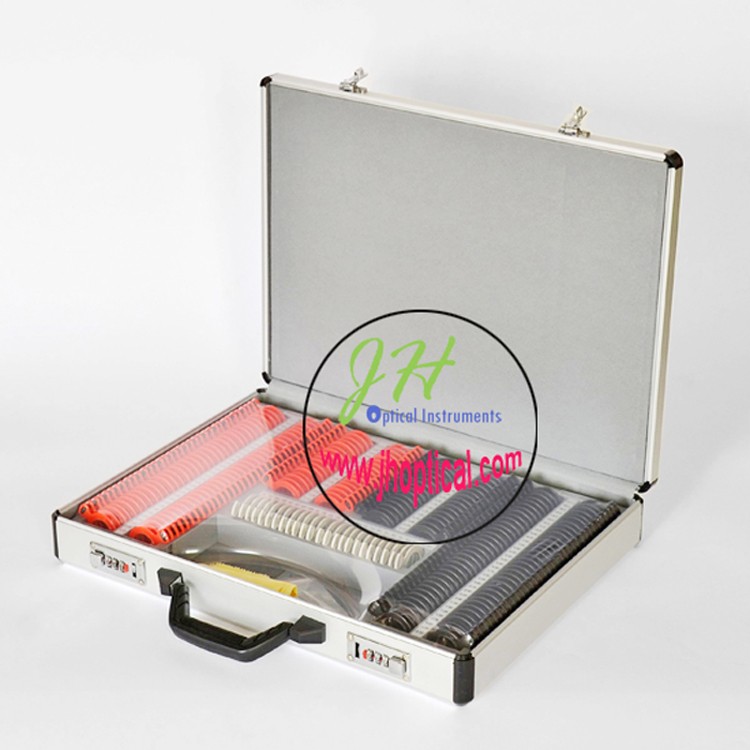
Spherical Lenses (Spheres)
These lenses have a curved surface that forms part of a sphere, providing the same dioptric power on all meridians. Light passing through a spherical lens converges to a single focal point (or a virtual focal point). Spherical lenses include concave (–) and convex (+) types, which are used to correct myopia, hyperopia, and presbyopia.
Cylindrical Lenses (Cylinders)
These lenses have a curved surface that forms part of a cylinder, with different dioptric powers along different meridians. Light passing through a cylindrical lens focuses into a straight line (or a broken line). Cylindrical lenses, available in both concave and convex forms, are used to correct astigmatism.
Prismatic Lenses (Prisms)
A prismatic lens has a wedge-shaped cross-section. Light passing through it bends toward the base of the prism, causing the perceived image to shift toward the apex. These lenses are used to detect and measure phorias, tropias, and latent strabismus, as well as for orthoptic exercises to train eye muscles.
Occluder
This is an opaque lens used to cover the eye not being examined, typically in a darkened room.
Frosted Lens
This is a semi-transparent cover lens. It is primarily used for examining infants and young children, or as an occluder in well-lit environments.
Slit Lens
This lens has a narrow slit in its center, allowing light to pass only through that opening. By rotating this lens in front of the eye, the examiner can assess astigmatism: if vision improves or worsens at a specific axis, astigmatism is indicated; if vision remains unchanged, astigmatism is likely absent.
Plain Lens
This is a transparent lens with no refractive power; light passes through it without bending. It is used in tests for malingering or functional vision loss (e.g., to evaluate suspected feigned blindness).
Color Lenses
These lenses come in various colors, including red, green, blue, yellow, and dark brown. They are used to assess color sensitivity. For patients with cloudy ocular media (e.g., those with cataracts), red or green lenses can be particularly useful. They can also be used for cross-checking refractions and for testing color vision deficiencies.
Cross Cylinder Lens
This lens has opposite cylindrical powers along two perpendicular axes. It is used to refine the power and axis of a cylindrical lens for precise astigmatism correction. To use it, place the cross cylinder in front of the trial cylinder. First, align one axis of the cross cylinder with the trial cylinder's axis, then flip it 180°. If there is no change in vision, the cylinder power is likely correct; if not, adjust the power accordingly. To refine the axis, position the cross cylinder so that its axes are at 45° and 135° relative to the trial cylinder's axis, then flip it. Compare the clarity of vision between the two positions. If one position provides better vision, rotate the trial cylinder's axis slightly toward the mark of that better position. Repeat this process until the vision is equal in both flipped positions, confirming the correct cylinder axis.
Maddox Rod
This lens features a series of parallel cylindrical grooves or bars on its surface. Light passing through it is focused into a line oriented perpendicular to the grooves. It is used to detect and measure heterophoria (latent strabismus).
Pinhole
This is an opaque disc with a small central aperture that allows light to pass through, creating an artificial pupil. It is used to improve visual acuity by reducing the blur circle, and is particularly helpful in estimating the potential for visual improvement in uncorrected astigmatism.
Related News

20231108105138.jpg "view article detail: Smart Tips for Heating Optical Frames")